
When Your Family Needs More Help | Children's Social Care & SEND Guide
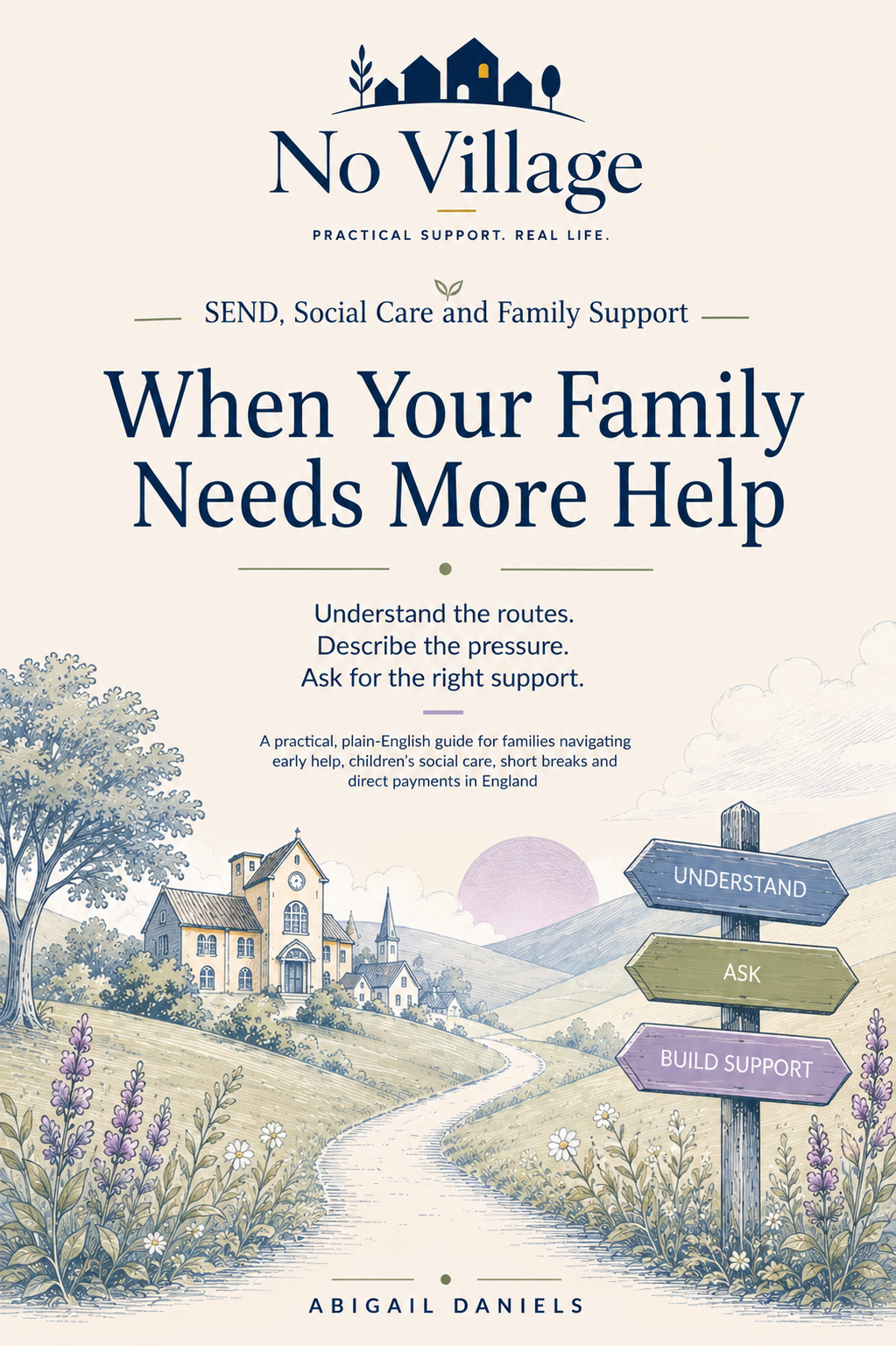
When Your Family Needs More Help
An 81-page practical guide to children's social care and family support for parents and carers in England. Includes 20 guidance chapters and 25 printable tools to help you understand assessments, ask for support, explore short breaks and respite, and navigate direct payments and support planning.
Knowing your family needs more support is one thing. Knowing which service to contact, what assessment to ask for and how to explain your circumstances is another.
Families raising disabled children or children with special educational needs and disabilities (SEND) can find themselves carrying far more than one household can reasonably sustain.
You may be managing constant supervision, disrupted sleep, school difficulties, sibling needs, appointments, paperwork, work pressures and the responsibility of making everything hold together.
Yet knowing how to access practical family support isn't always straightforward.
When Your Family Needs More Help explains the routes into children's social care and family support in England, helping you describe what your family needs, prepare for assessments and ask clearer questions about what support may be available.
Understand the routes. Describe the pressure. Ask for the right support.
What's included in the guide?
The guide contains 20 practical chapters covering:
Understanding children's social care and family support
- Children's social care: Understanding the different routes into support, including Family Help, children in need and safeguarding processes.
- Section 17 of the Children Act 1989: Understanding the child in need framework and its relevance to disabled children and their families.
- Asking for an assessment: How to prepare a request for a child and family assessment and explain the support your family needs.
- Parent carer needs assessments: Understanding the assessment route for parents caring for disabled children.
- Siblings and young carers: Recognising when caring arrangements affect other children in the household.
Exploring practical support
- Short breaks and respite: Understanding different types of short breaks and how to ask about appropriate provision.
- Direct payments and personal budgets: Exploring how these arrangements may work and what to consider before accepting them.
- Employing a personal assistant: Understanding practical planning and employment responsibilities that may arise.
- Family support plans: Asking for provision that is specific, realistic and capable of meeting identified needs.
- Social care and EHCPs: Understanding how children's social care support can relate to an Education, Health and Care Plan.
When support is refused or stops working
- Understanding eligibility thresholds and decisions.
- Responding when a family is told it does not qualify for support.
- Reviewing support that is reduced, delayed or no longer meets identified needs.
- Understanding complaints and escalation routes.
- Preparing practical arrangements for difficult or unexpected situations.
25 printable family support tools
The guide also includes 25 practical worksheets, checklists, templates and planning tools, including:
- Two-minute family pressure map.
- Family support-gap snapshot.
- Local services contact planner.
- Child and family assessment request template.
- Parent carer needs assessment request.
- One-page child profile.
- Family impact summary.
- Evidence checklist and assessment preparation sheet.
- Sibling and young carer impact record.
- Outcomes and support planner.
- Short breaks request and comparison tools.
- Direct payment decision checklist.
- Personal assistant role planner.
- Employer responsibilities checklist.
- EHCP social care checklist.
- Support plan review and missed-support trackers.
- Response to a refusal or eligibility decision.
- Complaint planner.
- Family crisis plan.
- Next 14 days action plan.
The tools are designed to help you explain your family's circumstances, organise important information and prepare for conversations without having to rebuild everything from memory.
Who is this guide for?
This guide is designed for parents and carers in England who are:
- Raising a disabled child or a child with SEND who needs additional practical support.
- Struggling to manage caring responsibilities without reliable backup.
- Unsure how to approach children's social care or family support services.
- Considering requesting a Section 17 child in need assessment.
- Seeking a parent carer needs assessment.
- Trying to access short breaks, respite or additional care support.
- Exploring direct payments or personal budgets.
- Concerned about the impact of caring responsibilities on siblings or family life.
- Finding that existing support is insufficient, unreliable or no longer appropriate.
- Trying to understand a refusal, eligibility decision or complaint route.
You do not need to wait until your family reaches crisis point to ask what support may be available.
Asking for help is not the same as failing to cope
Families can feel anxious about approaching children's social care, particularly when they are unfamiliar with the difference between family support and safeguarding processes.
Children's social care includes routes intended to support children and families, as well as responsibilities for responding to safeguarding concerns.
Requesting help does not, by itself, mean that a parent has harmed their child or that child protection action will follow.
However, professionals may need to consider safeguarding matters where concerns arise. This guide does not promise that a particular referral or assessment will follow one specific pathway.
Instead, it helps you understand the different routes, describe your family's support needs and ask for clarity about decisions and next steps.
Practical support without more pressure
You do not need to read all 81 pages in order.
Start with the issue you're facing.
If you're unsure who to contact, begin with the sections on family support. If you're preparing an assessment request, use the assessment tools. If you need short breaks or are considering direct payments, go directly to those chapters.
You don't have to complete every worksheet or create a perfect record of family life.
The aim is to make the support gap visible, understand the available routes and help you ask for arrangements that can actually be used.
You do not have to prove that your family has already broken down before asking for help.
Part of the No Village SEND Support Library
This guide forms part of the No Village collection of practical resources for families navigating education, health and support systems without enough safe, reliable or accessible backup.
It complements When You Don't Have a Village by Abigail Daniels, but can be used independently.
No Village challenges the assumption that every family has someone available to step in when everyday responsibilities become too much.
These resources aim to reduce some of the additional work involved in navigating complicated systems and organising practical support.
Use what helps. Leave what doesn't.
Digital download
Format: 81-page digital PDF guide
Includes: 20 chapters and 25 printable tools
Region: England
Price: £7.99
Author: Abigail Daniels
Edition: First Edition, Version 1.0
This is a digital download. No physical product will be posted.
You can download, save and print the guide for your own personal or household use.
Personal use and organisational licensing
Your purchase includes a Personal Use Licence for the purchaser.
Reproducing, sharing, redistributing or using this publication with clients, service users, families, groups or organisations requires appropriate permission or an organisational licence, except where permitted by law.
For professional or organisational enquiries, visit novillage.co.uk.
Important information
This guide provides general information and practical support. It does not provide individual legal, social-care, safeguarding, employment, tax, payroll, medical, financial or benefits advice.
The law, statutory guidance, local authority arrangements, eligibility criteria and service availability can change. An assessment or request does not guarantee a particular service or outcome.
Guidance and official sources were last checked on 26 August 2026.
Check current official information and seek appropriate specialist advice where needed, particularly for urgent safeguarding concerns, disputed decisions, legal deadlines or situations that could significantly affect your child or family.
This is an independently published No Village guide and is not produced, approved or endorsed by a local authority, government department or other organisation referenced within the publication.