
Hospital Care When You Have No Backup | NHS Discharge Planning Guide
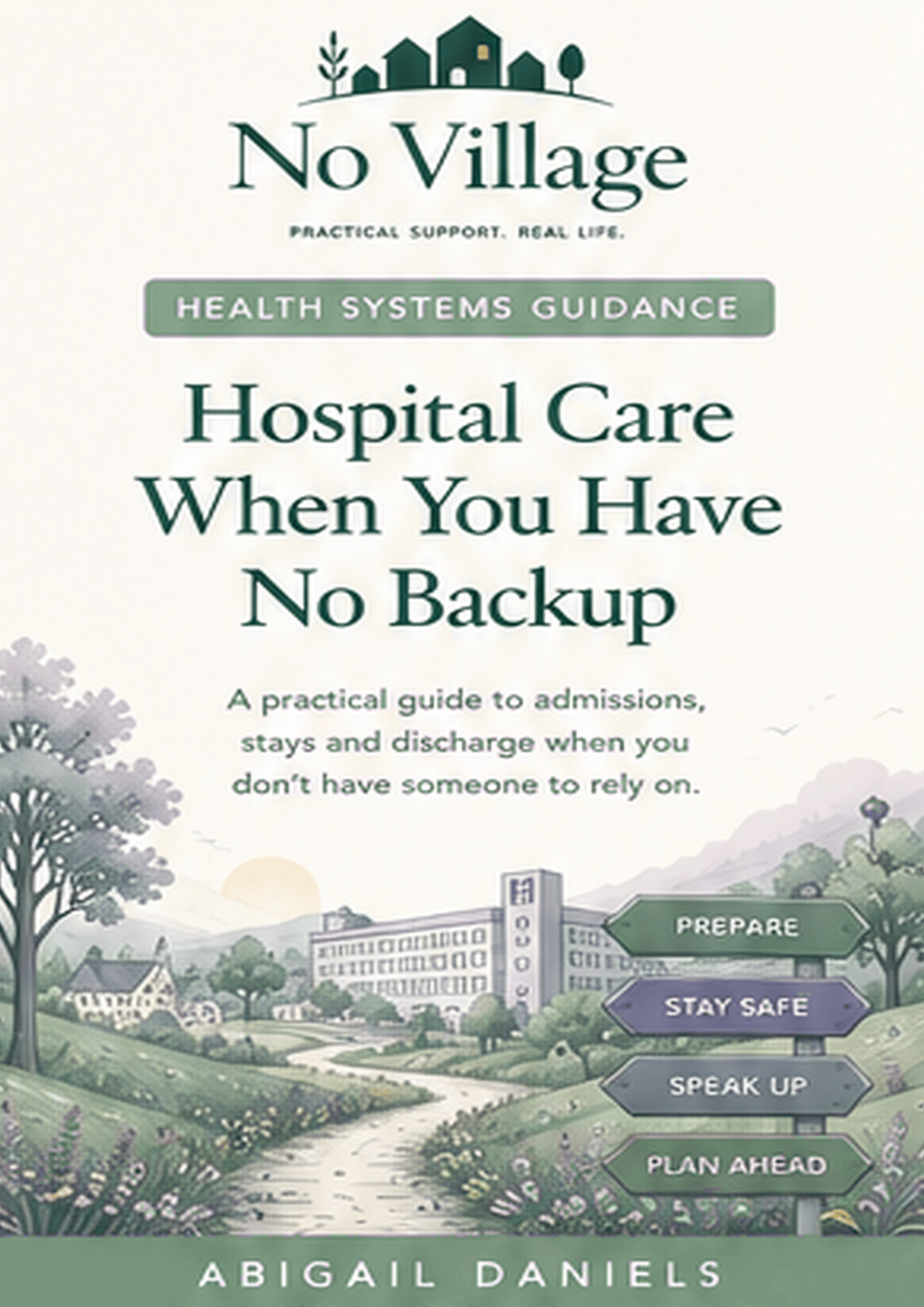
Hospital Care When You Have No Backup
A practical 72-page guide to NHS hospital admissions, discharge planning and recovery when you live alone or don't have reliable family or practical support. Includes 16 guidance chapters and 13 printable tools to help you prepare for hospital care, explain support gaps and plan for what happens afterwards.
Hospital care often assumes someone else is there. But what happens when they aren't?
Who will collect you after a procedure? Who can stay overnight? Who will help you get home, collect medication, look after your children or support you while you recover?
You may live alone, have no nearby family, be estranged from relatives or have people in your life who simply cannot provide the practical help being requested.
Having an emergency contact does not automatically mean having someone who can care for you.
Hospital Care When You Have No Backup helps you identify the support you actually have, explain what is missing and prepare for conversations with NHS hospital teams about your care and discharge arrangements.
The guide doesn't assume you can simply ask a relative or friend to step in.
Prepare. Ask. Record. Plan around what is real.
What's included in the guide?
The guide contains 16 practical chapters covering the different stages of hospital care.
Before going into hospital
- Preparing for hospital admission: Identifying the arrangements you need to make before planned care.
- Hospital transport: Understanding possible travel arrangements and what to ask when you cannot get to or from hospital independently.
- Escorts and responsible adults: Understanding why some procedures require an escort or responsible adult and how to explain when nobody is available.
- Responsibilities at home: Planning around children, caring responsibilities, pets and other essential tasks during an admission.
While you're in hospital
- Unexpected and emergency admissions: Keeping essential information together when hospital care wasn't planned.
- Communicating without an advocate: Preparing questions, recording decisions and explaining your circumstances when you're attending alone.
- Reasonable adjustments: Understanding how to request appropriate communication or access adjustments.
- Managing an inpatient stay: Keeping track of medication, practical needs and important information.
- Raising concerns: Understanding how to ask for help when something is wrong or your concerns are not being addressed.
Discharge planning and recovery
- Hospital discharge when living alone: Preparing for discharge when nobody is waiting at home.
- Explaining missing support: Identifying practical tasks that a proposed discharge arrangement assumes somebody else will provide.
- Recovery without family support: Planning the first days at home, including medication, meals, mobility, appointments and follow-up.
- Hospital complaints and escalation: Understanding PALS, complaints and other relevant routes when concerns remain unresolved.
The guide also includes quick-reference information for times when your energy, concentration or capacity is limited.
13 printable hospital planning tools
Alongside the guidance, you'll find 13 reusable worksheets, checklists, templates and trackers, including:
- One-page hospital care plan.
- No-backup statement.
- Transport and escort plan.
- Responsibilities at home plan.
- Hospital bag checklist.
- Communication support card.
- Reasonable adjustment request.
- Medicines and allergies record.
- Questions and decision log.
- Discharge and home recovery plan.
- Contact and follow-up log.
- Concern and complaint chronology.
- Emergency admission plan.
These tools are designed to reduce the amount you have to remember, explain and reconstruct when you're already dealing with illness, pain, fatigue or uncertainty.
You can use them before, during or after hospital care.
Who is this guide for?
This guide is primarily for adults navigating NHS hospital care in England who:
- Live alone or don't have reliable family support.
- Have no one available to collect them from hospital.
- Are concerned about discharge arrangements or recovering at home.
- Have an emergency contact who cannot provide practical care.
- Have children, pets or other caring responsibilities.
- Need reasonable adjustments or communication support.
- Are preparing for planned surgery, day procedures or an inpatient admission.
- Are worried about how they will manage after leaving hospital.
- Want to prepare questions or raise concerns about hospital arrangements.
Some tools may also help carers or supporters assisting another adult.
Specialist pathways, including maternity, paediatric care and compulsory mental-health treatment, may involve different requirements.
Designed around the support you actually have
Hospital care can involve a considerable amount of practical work outside the treatment itself.
Someone may need to arrange transport, collect medication, remember instructions, prepare meals, manage responsibilities at home or notice if your condition deteriorates after discharge.
When there is no second person available, those tasks do not disappear.
This guide helps you identify what is needed, what support is genuinely available and which questions to raise with the professionals responsible for your care.
It cannot replace human help, arrange services or determine whether a discharge plan is clinically appropriate.
You should not have to invent a village to receive care.
Practical guidance without more pressure
You don't need to read all 72 pages in order.
If you're preparing for an admission, begin with the hospital planning tools.
If you've been told somebody must collect you, start with the chapters about escorts and responsible adults.
If discharge is approaching, use the discharge planning and recovery sections.
Use whichever pages help with your immediate situation.
Use what helps. Leave what doesn't.
Part of the No Village Health Systems Library
No Village creates practical resources for people navigating healthcare and everyday systems without enough safe, reliable or accessible backup.
This guide recognises the hidden work patients may be expected to manage while unwell, particularly when services assume another person is available to help.
It offers practical scaffolding to help you prepare, organise information and make those support assumptions visible.
Practical support, not assumptions.
Digital download
Format: 72-page digital PDF guide
Includes: 16 guidance chapters and 13 printable tools
Region: England
Price: £7.99
Author: Abigail Daniels
Edition: First Edition, Version 1.0
This is a digital product. No physical item will be posted.
You can download, save and print the guide for your own personal or household use.
Personal use and organisational licensing
Your purchase includes a Personal Use Licence.
You may download and print copies for personal or household use and adapt the example scripts or templates for that purpose.
Sharing, reproducing, redistributing or using the publication as an organisational resource requires appropriate written permission or a separate licence, except where permitted by law.
For professional or organisational enquiries, visit novillage.co.uk.
Important information
This guide provides general information and practical navigation support. It does not provide individual medical or legal advice, assess whether hospital admission or discharge is appropriate, or recommend treatment.
Hospital requirements, discharge procedures, transport eligibility and available support vary according to individual circumstances, clinical needs and local arrangements.
Guidance and official sources were last checked on 10 September 2026.
Always check current official information and follow the advice of the healthcare professionals responsible for your care.
For urgent medical advice, contact NHS 111. For a life-threatening emergency, call 999 or attend A&E.
This is an independently published No Village guide and is not produced, approved or endorsed by the NHS, NHS England, any hospital trust or other organisation referenced in the publication.