
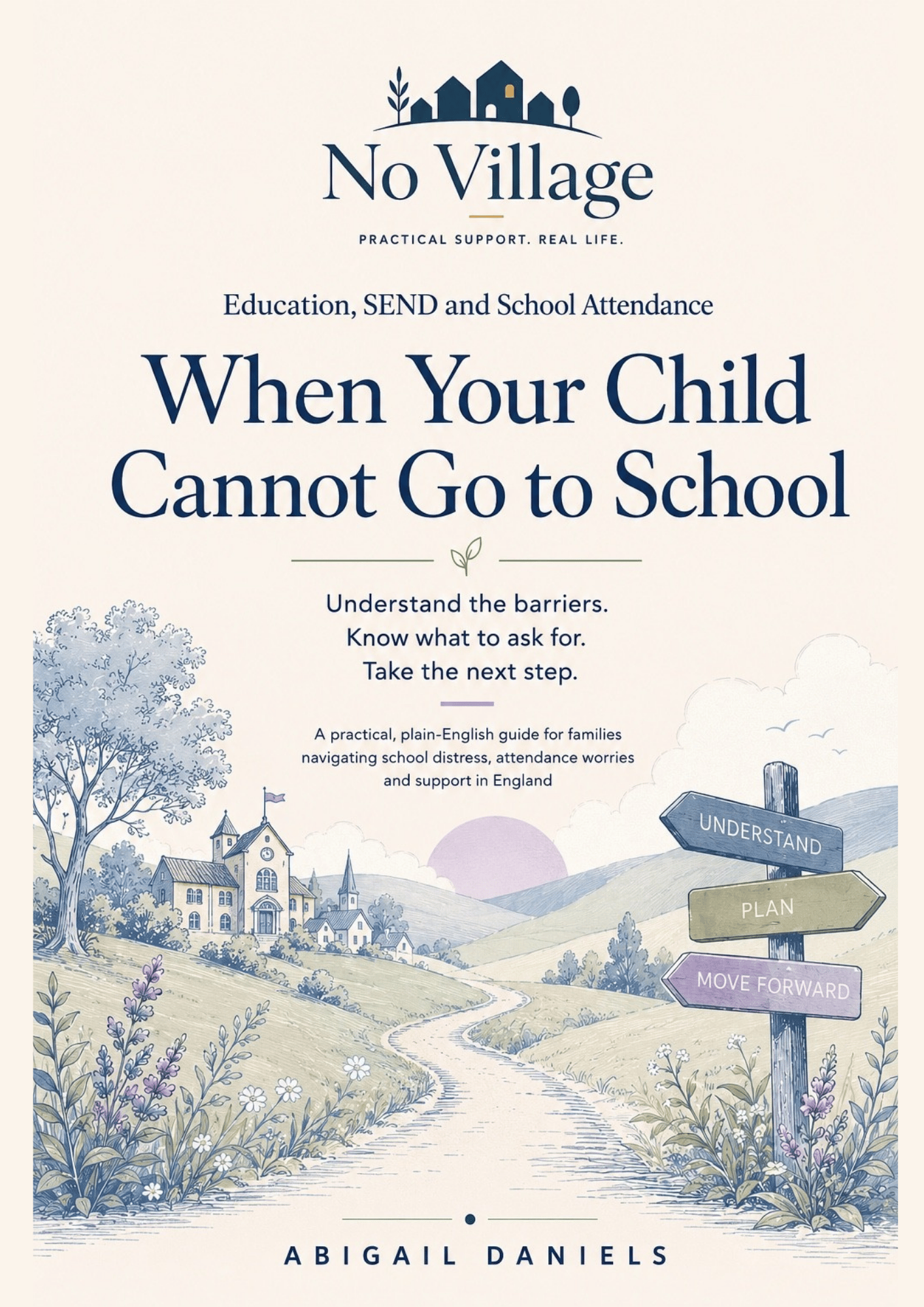
When Your Child Cannot Go to School | School Distress & Attendance Guide
When Your Child Cannot Go to School
A practical 72-page guide for parents and carers in England navigating school distress, emotionally based school avoidance (EBSA), attendance difficulties and SEND support. Includes 20 guidance chapters and 16 printable tools to help you understand barriers, prepare for school meetings and explore appropriate next steps.
When your child cannot reliably attend school, everyday family life can quickly become overwhelming.
Mornings may involve anxiety, tears, shutdowns, physical symptoms or distress. Your child may appear to cope at school but struggle significantly at home. Meanwhile, attendance letters, meetings, pressure from school and concerns about missed education continue.
You may hear terms such as school refusal, school anxiety, EBSA or emotionally based school non-attendance. These terms don't explain every child's situation, and the support needed depends on the circumstances.
When Your Child Cannot Go to School helps you understand what may be preventing attendance, ask clearer questions, organise useful information and explore the support and education arrangements available in England.
Understand the barriers. Know what to ask for. Take the next step.
What's included in the guide?
The guide contains 20 practical chapters covering:
- Understanding school distress: Identifying possible barriers including anxiety, unmet SEND needs, sensory difficulties, bullying, health concerns and exhaustion.
- The next 48 hours: Working out what needs immediate attention when attendance has become difficult.
- School attendance rules: Understanding absence records, attendance codes and communication with school.
- SEN Support and reasonable adjustments: Exploring support and changes that may help your child access education.
- Attendance support plans: Preparing for meetings and asking for practical arrangements that reflect your child's needs.
- Part-time timetables and phased returns: Understanding important considerations when reduced attendance is proposed.
- Health and medical evidence: Organising relevant information and understanding the role of health professionals.
- EHCPs and school attendance: Understanding how Education, Health and Care Plans relate to attendance difficulties.
- Section 19 and alternative education: Understanding when local authority duties to arrange suitable education may need to be considered.
- Attendance warnings and legal action: Understanding the different processes and identifying when specialist advice may be needed.
- Informal exclusions and elective home education: Recognising important decisions and questions before accepting changes to your child's education.
- Rebuilding access to education: Considering what a sustainable, child-centred plan might involve.
- Protecting family life: Recognising the impact on work, siblings, finances and caring responsibilities.
16 printable school attendance tools
The guide also includes 16 practical worksheets, checklists, templates and trackers, including:
- 48-hour action plan.
- School barriers map.
- Attendance and distress tracker.
- One-page child summary.
- School meeting preparation sheet.
- Reasonable adjustments menu.
- Attendance support plan.
- Part-time timetable checklist.
- Ready-to-adapt school meeting email.
- Attendance records and codes request.
- SEN Support and adjustments review request.
- Section 19 consideration request.
- Attendance warning response template.
- Escalation map.
- Reintegration review.
- Contacts and records tracker.
These tools are designed to help you record what is happening, prepare questions, explain your child's needs and follow up on important conversations.
Who is this guide for?
This guide is for parents and carers in England whose child:
- Is experiencing anxiety, distress or significant difficulty attending school.
- Has stopped attending school or is struggling with attendance.
- Appears fine at school but experiences substantial distress before or afterwards.
- Has SEND or possible additional needs that may not be fully understood.
- Is experiencing difficulties with a proposed return-to-school plan.
- Has been offered a part-time timetable or phased return.
- Is missing education while suitable arrangements remain unclear.
It may also help parents who are:
- Receiving attendance warnings or concerned about possible fines.
- Seeking reasonable adjustments or additional SEN Support.
- Trying to understand whether Section 19 may be relevant.
- Considering their options after communication with school has broken down.
Practical guidance without more pressure
You do not need to read the entire guide or complete every worksheet.
Start with the issue in front of you.
If today is a crisis, begin with the immediate planning section. If school is questioning attendance, use the chapters about attendance records and support. If your child is missing education, explore the relevant chapters about alternative arrangements and local authority responsibilities.
The guide does not promise a quick solution or recommend forcing a child into school regardless of their circumstances.
Instead, it helps you make barriers visible, prepare useful information and explore realistic steps towards suitable education.
Use what helps. Leave what doesn't.
Part of the No Village SEND Support Library
No Village recognises that school attendance difficulties can place enormous pressure on families, particularly where parents are expected to collect children at short notice, attend repeated meetings, absorb lost earnings and coordinate services without reliable backup.
This guide is part of the No Village collection of practical resources designed to reduce some of that additional work.
It complements When You Don't Have a Village by Abigail Daniels but can be used independently.
Digital download
Format: 72-page digital PDF guide
Includes: 20 guidance chapters and 16 printable tools
Region: England
Price: £7.99
Author: Abigail Daniels
Edition: First Edition, Version 1.0
Guidance and sources last checked: 1 September 2026
This is a digital product. No physical item will be posted.
The guide is supplied under a Personal Use Licence. Separate permission or an organisation licence is required for organisational or professional distribution and use, except where permitted by law.
For licensing enquiries, visit novillage.co.uk.
Important information
This guide provides general educational information, practical tools and navigation support. It is not individual legal, medical, mental health, safeguarding, educational or financial advice.
School attendance rules, statutory guidance, local authority arrangements, processes and deadlines may change.
Check current official guidance and seek appropriate specialist advice, particularly where there are legal deadlines, attendance enforcement concerns, disputes about education provision or urgent safeguarding issues.
Using the guide does not guarantee a particular decision, education arrangement or outcome. Where there is an immediate risk to someone's safety, seek appropriate emergency support.