
When Your GP Is the Barrier | GP Complaints & Patient Rights Guide
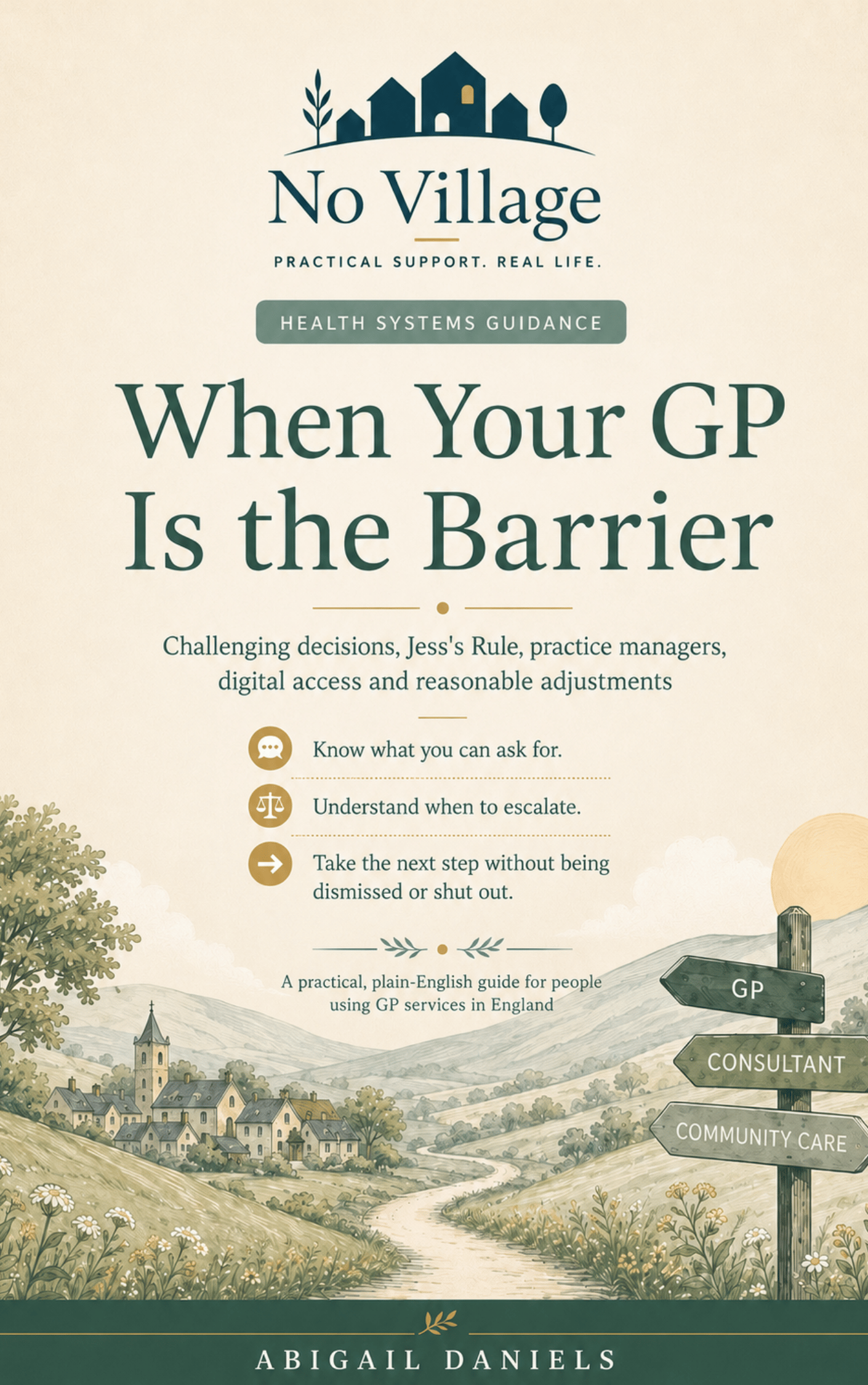
When Your GP Is the Barrier
A practical 77-page guide to GP access, complaints, reasonable adjustments and challenging decisions in England. Includes 15 guidance chapters and 14 printable tools to help you understand your options, prepare requests, organise evidence and identify appropriate next steps.
Getting help from your GP should not become another problem you have to solve.
You may be struggling to get an appointment, unable to use an online consultation system, repeatedly explaining the same symptoms or trying to understand why a referral, test or request has been declined.
Perhaps you've asked for a reasonable adjustment that hasn't been provided, received conflicting information or reached the point where you need to speak to the practice manager.
When Your GP Is the Barrier helps you navigate these situations through clear explanations, practical questions, ready-to-adapt scripts and tools for recording what has happened.
The aim isn't to turn every disagreement into a complaint. It's to help you understand the problem, ask for an appropriate response and work out what to do next.
Know what you can ask for. Understand when to escalate. Take the next step without being dismissed or shut out.
What's included in the guide?
The guide contains 15 practical chapters covering:
Getting access to GP services
- Understanding your GP practice: How different roles and responsibilities fit together.
- GP appointment and access problems: Identifying whether the barrier relates to access, administration or clinical decision-making.
- Online consultation systems: Navigating difficulties with Anima, eConsult and other digital access routes.
- Reasonable adjustments: Understanding how to request adjustments when disability or access needs make standard processes difficult.
Challenging decisions and asking for reviews
- Challenging a GP decision: How to ask for an explanation or clinical reconsideration when concerns remain unresolved.
- When your GP says no: Preparing questions about declined referrals, tests, examinations or other requests.
- Jess's Rule: Understanding the NHS initiative encouraging fresh consideration when a patient presents repeatedly with the same unresolved symptoms or concerns.
- Persistent or worsening symptoms: Keeping records and recognising when further clinical advice may be needed.
Complaints, records and escalation
- Contacting the practice manager: Preparing a clear request and identifying the outcome you are seeking.
- GP complaints: Understanding informal resolution, formal complaints and relevant escalation routes.
- Medical records: Asking for clarification or correction when information is inaccurate or incomplete.
- Changing GP practice: Considering continuity of care and practical arrangements.
- Urgent health concerns: Understanding why immediate clinical needs must be addressed separately from administrative challenges.
- Navigating without reliable backup: Reducing the additional work of managing healthcare access, records and follow-up.
14 printable GP access and complaint tools
The guide also includes 14 practical worksheets, checklists, templates and trackers, including:
- GP barrier issue sorter.
- Appointment and challenge preparation worksheet.
- Jess's Rule tracker.
- Clinical decision review request.
- Record of a declined GP request.
- Digital access barrier record.
- Reasonable adjustment request template.
- Practice manager escalation email.
- Formal GP complaint planner.
- Medical record correction or clarification request.
- Changing GP practice checklist.
- Symptom and safety-netting record.
- Contact and action log.
- Escalation decision sheet.
These tools are designed to help you organise information, prepare questions and explain what happened without having to repeatedly reconstruct everything from memory.
Who is this guide for?
This guide is for people using GP services in England who are:
- Struggling to obtain appointments or access GP services.
- Unable to use online consultation systems effectively.
- Living with disabilities, chronic illness or other access needs.
- Trying to request reasonable adjustments from their GP practice.
- Seeking an explanation or reconsideration of a clinical decision.
- Concerned about repeated appointments for unresolved symptoms.
- Unsure how to contact a practice manager.
- Considering making a formal GP complaint.
- Trying to resolve administrative errors or inaccurate medical records.
- Navigating healthcare without reliable practical or advocacy support.
You do not need to be making a formal complaint to use this guide.
Practical GP guidance without more pressure
You do not need to read all 77 pages in order.
Start with the issue you're dealing with now.
If an online consultation form is preventing you from accessing care, begin with the digital access chapters. If you need a reasonable adjustment, use the relevant guidance and request template.
If you're considering a complaint, start with the sections that help you identify the problem, describe the impact and explain what response you're seeking.
The aim is to make your next action clearer, not to give you another complicated system to maintain.
Use what helps. Leave what doesn't.
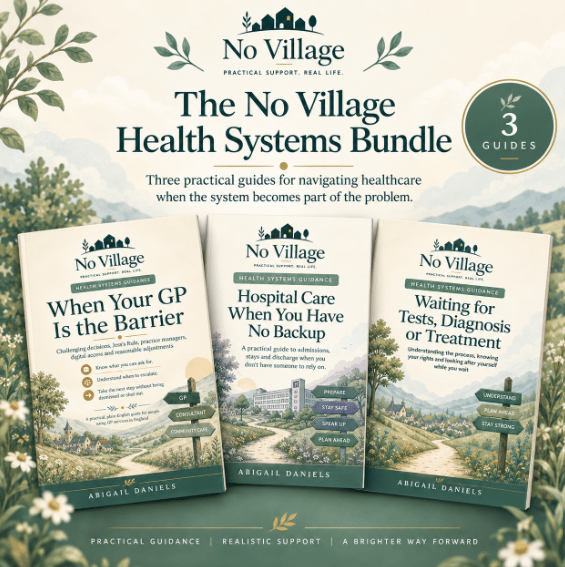
Part of the No Village Health Systems Library
This guide forms part of the No Village collection of practical resources for people navigating healthcare and everyday systems without enough safe, reliable or accessible backup.
No Village recognises that healthcare processes can assume patients have the time, energy, confidence and practical support to keep making calls, completing forms, chasing decisions and explaining their circumstances.
Those assumptions can create additional barriers for people who are already unwell, exhausted or managing significant responsibilities.
These resources aim to reduce some of that burden through clear explanations and reusable tools.
Practical support, not assumptions.
Digital download
Format: 77-page digital PDF guide
Includes: 15 guidance chapters and 14 printable tools
Region: England
Price: £7.99
Author: Abigail Daniels
Edition: First Edition, Version 1.0
This is a digital download. No physical product will be posted.
You can download, save and print the guide for your own personal or household use.
Personal use and organisational licensing
Your purchase includes a Personal Use Licence.
Reproducing, sharing, redistributing or using this publication with clients, patients, service users, groups or organisations requires appropriate permission or an organisational licence, except where permitted by law.
For professional or organisational enquiries, visit novillage.co.uk.
Important information
This guide provides general information and practical navigation support. It does not provide individual medical, clinical or legal advice, determine whether a test or referral is necessary, or guarantee a particular response or outcome.
The guide is independently published and is not produced, approved or endorsed by the NHS, NHS England, a GP practice, professional regulator or government department.
Guidance and official sources were last checked on 31 August 2026.
NHS arrangements, policies, practice procedures, patient rights and complaint routes can change. Always check current official information and obtain appropriate professional advice where needed.
If you have urgent symptoms or your condition is worsening, seek timely clinical advice rather than waiting for a complaint or administrative review. For life-threatening emergencies, call 999 or attend A&E. For urgent medical help when you are unsure what to do, contact NHS 111.