
Getting School to Support Your Child | SEN Support Guide for Parents
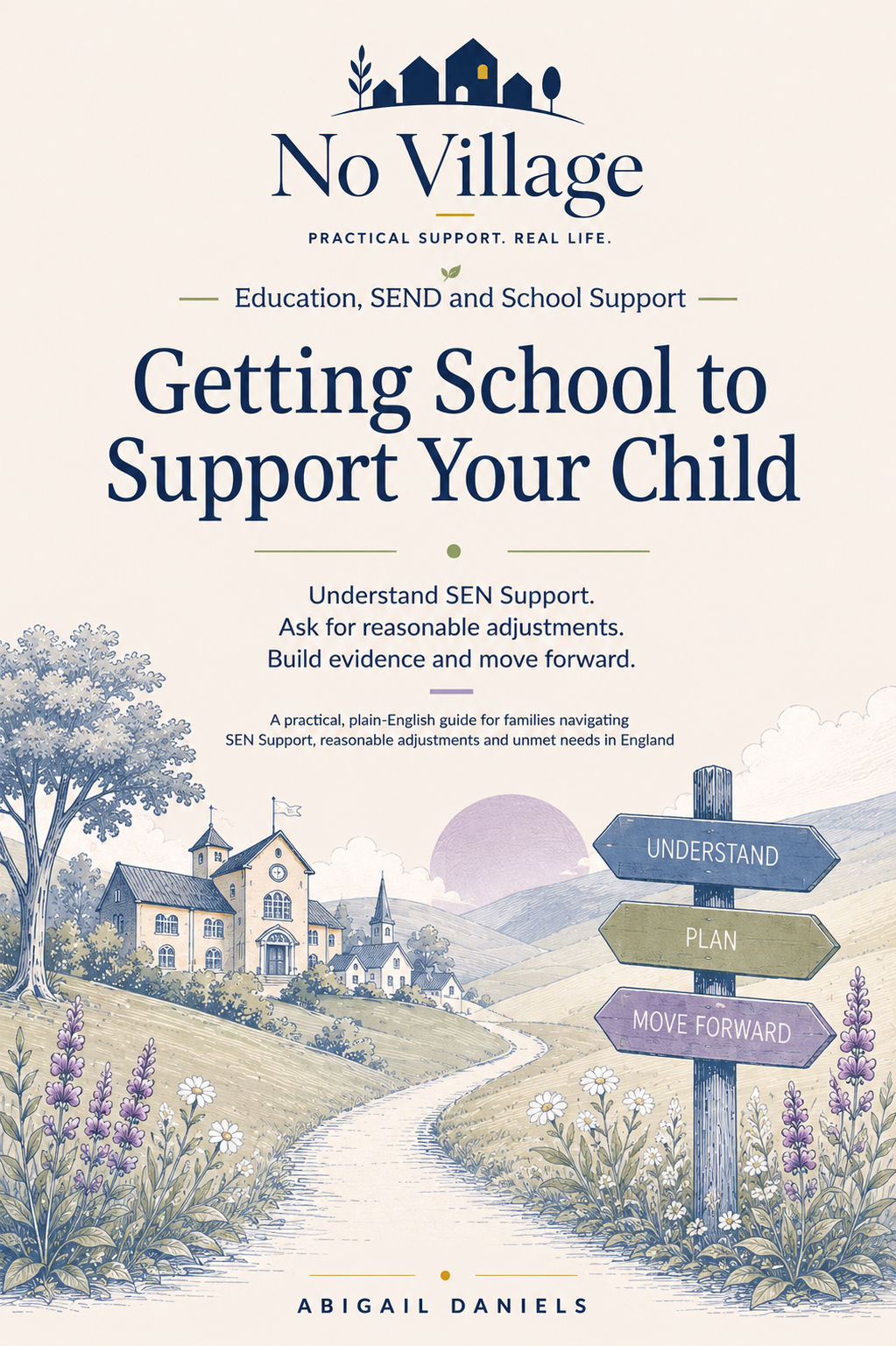
Getting School to Support Your Child
A practical SEN Support guide for parents and carers in England. This 74-page digital PDF includes 20 guidance chapters and 18 printable tools to help you understand school responsibilities, prepare for SENCO meetings, request reasonable adjustments and follow up when agreed support is not happening.
When your child is struggling at school, getting the right support can feel like another full-time job.
You may be worried about their learning, behaviour, attendance, anxiety or wellbeing, but find that conversations with school lead to vague assurances, repeated meetings or little practical change.
Perhaps you've been told your child needs a diagnosis first, that the SENCO is too busy, that funding isn't available or that support cannot be arranged without an EHCP.
Getting School to Support Your Child helps you understand the SEN Support process in England, identify what your child is finding difficult and ask clearer questions about what school will actually do.
Understand the options. Ask the right questions. Find out what support is being provided.
What's included in the guide?
The guide contains 20 practical chapters covering:
- Understanding SEN Support: What SEN Support is, how it works and how it differs from having an Education, Health and Care Plan (EHCP).
- Getting help without a diagnosis: Understanding how support needs can be identified and considered before a formal diagnosis.
- School and SENCO responsibilities: Who is involved in identifying needs, planning support and reviewing progress.
- Assess, Plan, Do, Review: Understanding the graduated approach and how to check whether interventions and support are working.
- SEN Support plans: What useful support plans, outcomes and provision should look like.
- Reasonable adjustments: Understanding adjustments for disabled children and how to raise requests with school.
- School and home differences: Explaining masking, distress and difficulties that may not be visible during the school day.
- Evidence and school meetings: Keeping useful records, preparing questions and following up on decisions.
- Funding and staffing concerns: Understanding how to respond when school says resources are unavailable.
- Behaviour, attendance and exclusions: Considering difficulties through a SEND lens.
- Missed support and escalation: What to do when agreed provision does not happen, including complaints and relevant escalation routes.
- When SEN Support may not be enough: Understanding when an EHC needs assessment may need to be considered.
18 printable SEN Support tools
Alongside the guidance, you'll find practical worksheets, scripts, checklists and trackers, including:
- Strengths and needs snapshot.
- Barriers to learning and participation map.
- First email template for contacting a teacher or SENCO.
- SENCO meeting preparation sheet.
- Questions to ask at your first meeting.
- Assess, Plan, Do, Review tracker.
- SEN Support plan quality checklist.
- Reasonable adjustments request template.
- Home-school differences and masking record.
- Evidence index and missed provision tracker.
- Review meeting record.
- Funding or staffing refusal response prompts.
- Escalation ladder.
- EHC needs assessment readiness checklist.
These tools are designed to help you make your concerns clearer, document what has been agreed and keep track of what happens next.
Who is this SEN Support guide for?
This guide is for parents and carers of compulsory-school-age children in England who are concerned that their child's needs are not being properly understood or supported at school.
It may be useful if:
- You are raising SEN concerns with school for the first time.
- School says your child needs a diagnosis before support can be considered.
- Your child is receiving SEN Support, but the plan is vague or ineffective.
- You are unsure what reasonable adjustments to ask about.
- Your child appears to cope at school but struggles significantly at home.
- You are concerned about behaviour sanctions, attendance difficulties or exclusion.
- Agreed support is repeatedly missed or not reviewed.
- You are trying to understand whether SEN Support is enough or an EHC needs assessment may be appropriate.
Your child does not need a diagnosis or an EHCP for you to use this guide.
The guide focuses primarily on mainstream maintained schools, academies and free schools in England. Some processes differ in other settings.
Practical support without more pressure
You do not need to read the guide from beginning to end.
Start with the chapter that matches the pressure you're dealing with now.
If you're preparing for a SENCO meeting, use the meeting tools. If school says it needs a diagnosis, go directly to that chapter. If support has been promised but not delivered, use the tracking and follow-up sections.
You do not have to complete every worksheet or challenge every decision.
The aim is to make conversations clearer, requests more specific and records easier to manage.
Use what helps. Leave what doesn't.
Part of the No Village SEND Support Library
This guide is part of the No Village collection of practical resources for families navigating education, health and support systems without enough reliable backup.
It complements When You Don't Have a Village by Abigail Daniels but can be used independently.
No Village recognises that families are often expected to research complicated systems, coordinate professionals, keep detailed records and repeatedly explain their child's needs while continuing to manage everyday responsibilities.
These resources aim to reduce some of that additional work.
Digital download
Format: 74-page digital PDF guide, including cover
Contents: 20 guidance chapters and 18 printable tools
Region: England
Price: £7.99
Author: Abigail Daniels
This is a digital product. No physical item will be posted.
You can download, save and print the guide for personal or household use.
Personal use and organisational licensing
Your purchase includes a Personal Use Licence for the purchaser.
Reproducing, sharing, distributing or using this publication as an organisational resource, including with clients, service users or families, requires appropriate permission or an organisation licence, except where permitted by law.
For professional or organisational licensing enquiries, visit novillage.co.uk.
Important information
This guide provides general educational information, practical prompts and organisation tools. It does not provide individual legal, medical or specialist educational advice.
It is written for families in England. Guidance and official sources were last checked on 14 August 2026.
SEND legislation, statutory guidance, school arrangements and relevant deadlines can change. Check current official information and seek specialist advice where appropriate, particularly for urgent safeguarding concerns, exclusions, potential discrimination or legal deadlines.
This is an independently published No Village resource and is not produced or endorsed by the Department for Education, local authorities or other organisations mentioned in the guide.